Lucayan Archipelago
The Bahamas
Import permit neededRabies vaccine neededNo titer testVet certificate within 10 days of arrivalNo quarantine
Before you sail
- Import permit — apply at least 4 weeks before arrivalImport permitRequiredconfidence: AI-vetted. An AI read the cited document and quoted the text it found; where the wording differed from ours, an AI judged the two equivalent. Not yet checked by a human — read the quote.[12]
Evidence for Import permit
An import permit is required for the import of dogs and cats and must accompany the animal at the time of import
Import permit — apply ahead28 days (APPLY AT LEAST FOUR WEEKS AHEAD, though issuing takes days. USDA APHIS: "Apply at least 4 weeks in advance." BAHFSA's own guide says that after paying, "After 24–48 hours, log back into Click2Clear" and print the permit, and the Department's 2023 form says a complete application "CAN TAKE UP TO 48 BUSINESS HOURS TO PROCESS". The 6–8 weeks a commercial source gives is in no official document read here. BAHFSA's 2026 guide also lists a "Veterinary Health Certificate (issued within required timeframe)" among what to have ready before applying, and that certificate must fall within ten days of importation — so the permit may have to wait until the certificate is issued.)confidence: Inferred. Backed by an official source but not yet certified by a human reviewer.[47113] - Rabies vaccine between 10 months and 30 days before arrival; at least 12 weeks old when vaccinatedRabies vaccineRabies — max. before travelRabies — min. before travelRabies — min. age at vaccination
- Veterinary health certificate issued within 10 days of arrival, endorsed by the exporting country's veterinary authorityVeterinary health certificateRequiredconfidence: AI-vetted. An AI read the cited document and quoted the text it found; where the wording differed from ours, an AI judged the two equivalent. Not yet checked by a human — read the quote.[21]
Evidence for Veterinary health certificate
A veterinary health certificate is required at the time of import which should include certification that the animal is healthy, has an active immunity against rabies and satisfies all other health requirements.
Certificate — completed within10 days (TEN DAYS, COUNTED TO ARRIVAL RATHER THAN TO DEPARTURE. BAHFSA's Appendix 1 condition reads "an international veterinary certificate (within ten (10) days of importation) is required", so the clock runs to the day you clear in rather than the day you sail — which on a passage of any length is the harder of the two to satisfy. The US export certificate agrees on ten days but counts them back from leaving: the animals "were inspected within 10 days prior to export to the Bahamas". A boat must meet both. A commercial source states "within 48 hours of entry"; no official document read here says so, and the only 48 hours in official material is the time the permit takes to process.)confidence: AI-vetted. An AI read the cited document and quoted the text it found; where the wording differed from ours, an AI judged the two equivalent. Not yet checked by a human — read the quote.[2563]Evidence for Certificate — completed within
an international veterinary certificate (within ten (10) days of importation) is required
- Parasite treatment — internal and externalParasites — internalMust be free of internal parasites, evidenced by a negative stool-sample test.confidence: Inferred. Backed by an official source but not yet certified by a human reviewer.[2]Parasites — externalMust be free of external parasites.confidence: Inferred. Backed by an official source but not yet certified by a human reviewer.[2]Parasites — timingWithin ten days before leaving, for internal and external parasites both. The US export certificates: "Within 10 days prior to export: a. The animals were treated for external parasites. b. The animals were treated against internal parasites using broad-spectrum anthelmintic licensed for use in the United States."confidence: Inferred. Backed by an official source but not yet certified by a human reviewer.[563]
- Microchip — sources disagree whether it is required
- Dogs vaccinated against: Rabies, Distemper, Hepatitis, Leptospirosis, Parvovirus, Adenovirus, Parainfluenza (on the US export certificate)
- Cats vaccinated against: Rabies, Feline Leukemia, Rhinotracheitis, Calicivirus, Panleukopenia, Pneumonitis (Chlamydophila psittaci)
- Dogs and cats at least 6 months oldDogs — minimum age
Fees
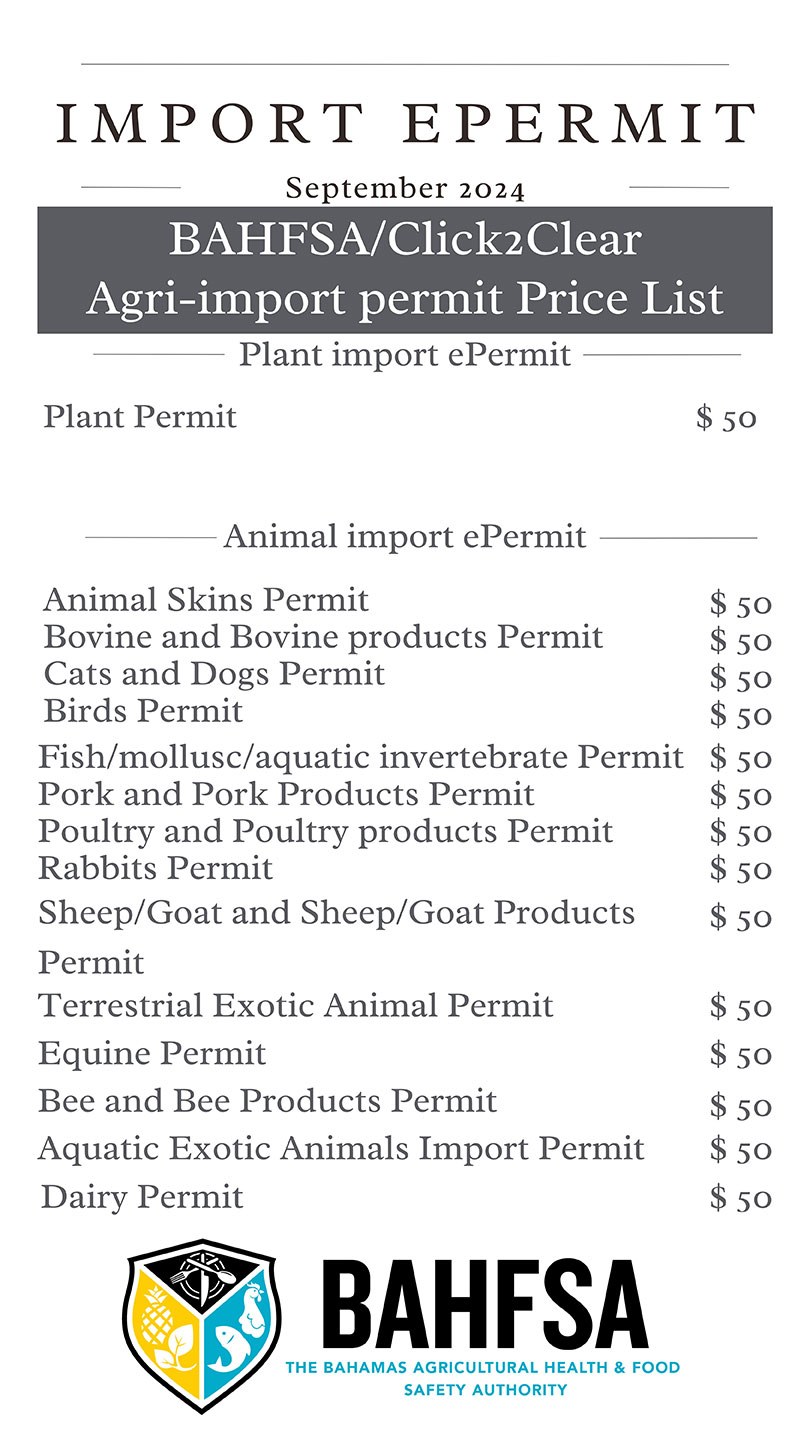
B$50 (US$50) per permit through BAHFSA's Click2Clear portal — "Cats and Dogs Permit $50" on BAHFSA's price list. The US$11.20 and US$44.00 figures on the Department of Agriculture's older pages predate the move to BAHFSA.confidence: Inferred. Backed by an official source but not yet certified by a human reviewer.[127111]
No figure is published, but a charge is possible: the Department's 2023 form warns that "OFFICIAL INSPECTION MAY BE REQUIRED IN THE BAHAMAS BY GOVERNMENT AUTHORIZED VETERINARIANS AND FEES MAY BE APPLIED AS VERIFIED BY AUTHORIZED VETERINARIANS."confidence: Inferred. Backed by an official source but not yet certified by a human reviewer.[11]
Timeline
- 10 months – 30 days before arrivalRabies vaccine given in this windowRabies vaccineRabies — max. before travel
- 4 weeks before arrivalApply for the import permitImport permitRequiredconfidence: AI-vetted. An AI read the cited document and quoted the text it found; where the wording differed from ours, an AI judged the two equivalent. Not yet checked by a human — read the quote.[12]
Evidence for Import permit
An import permit is required for the import of dogs and cats and must accompany the animal at the time of import
Import permit — apply ahead28 days (APPLY AT LEAST FOUR WEEKS AHEAD, though issuing takes days. USDA APHIS: "Apply at least 4 weeks in advance." BAHFSA's own guide says that after paying, "After 24–48 hours, log back into Click2Clear" and print the permit, and the Department's 2023 form says a complete application "CAN TAKE UP TO 48 BUSINESS HOURS TO PROCESS". The 6–8 weeks a commercial source gives is in no official document read here. BAHFSA's 2026 guide also lists a "Veterinary Health Certificate (issued within required timeframe)" among what to have ready before applying, and that certificate must fall within ten days of importation — so the permit may have to wait until the certificate is issued.)confidence: Inferred. Backed by an official source but not yet certified by a human reviewer.[47113] - 10 days – arrivalVeterinary health certificate issued in this windowVeterinary health certificateRequiredconfidence: AI-vetted. An AI read the cited document and quoted the text it found; where the wording differed from ours, an AI judged the two equivalent. Not yet checked by a human — read the quote.[21]
Evidence for Veterinary health certificate
A veterinary health certificate is required at the time of import which should include certification that the animal is healthy, has an active immunity against rabies and satisfies all other health requirements.
Certificate — completed within10 days (TEN DAYS, COUNTED TO ARRIVAL RATHER THAN TO DEPARTURE. BAHFSA's Appendix 1 condition reads "an international veterinary certificate (within ten (10) days of importation) is required", so the clock runs to the day you clear in rather than the day you sail — which on a passage of any length is the harder of the two to satisfy. The US export certificate agrees on ten days but counts them back from leaving: the animals "were inspected within 10 days prior to export to the Bahamas". A boat must meet both. A commercial source states "within 48 hours of entry"; no official document read here says so, and the only 48 hours in official material is the time the permit takes to process.)confidence: AI-vetted. An AI read the cited document and quoted the text it found; where the wording differed from ours, an AI judged the two equivalent. Not yet checked by a human — read the quote.[2563]Evidence for Certificate — completed within
an international veterinary certificate (within ten (10) days of importation) is required
- ArrivalPresent the permit and certificate; clear the animal before going ashore.
On arrival & aboard
- At the dock
- The import permit must accompany the animal at the point of entry and all permit conditions must be met, or the animal may be refused entry or confiscated.
- By yacht
- THE PERMIT HAS A ROUTE FOR BOATS; THE ARRIVAL DOES NOT. BAHFSA's Click2Clear permit application has you "choose Air Transport or Maritime Transport" and name the "Port of Arrival" and its "Customs Office", so a yacht applies like anyone else. At clearance the one animal question on the forms read here is on Customs' Maritime Declaration of Health: "Is there a sick animal or pet on board?" Customs' pleasure-vessel page names the forms — the inward declaration and cruising permit application (C2A) and that health declaration — and says nothing else about animals. The "IMP1(B) form" a commercial source tells boats to carry appears in no official document read here; the permit is issued as "BAHFSA-PERMIT TO IMPORT CATS AND DOGS". Whether an inspector meets the boat is not stated; the Department's 2023 form warns that "OFFICIAL INSPECTION MAY BE REQUIRED IN THE BAHAMAS BY GOVERNMENT AUTHORIZED VETERINARIANS AND FEES MAY BE APPLIED". The going-ashore grade above still rests on the commercial source alone.
Quarantine
No quarantine is imposed when all import requirements are met.confidence: Inferred. Backed by an official source but not yet certified by a human reviewer.[2]
If the animal stays aboard
- Note
- No source located says what applies to an animal that stays aboard and never lands. What the official documents do is treat an animal aboard as part of the arrival: the permit application has a "Maritime Transport" route naming the port and customs office, and the health declaration every arriving vessel files asks "Is there a sick animal or pet on board?" Nothing exempts an animal kept aboard. Assume the full import requirements apply until BAHFSA confirms otherwise in writing.
Open questions
- Confirm whether an animal that stays aboard and never lands needs the permit and the health certificate. Nothing published says so either way; the permit's Maritime Transport route and the health declaration's pet question both treat an animal aboard as arriving.
- Confirm whether a microchip is required for an animal certified outside the United States. The US export certificates require one, implanted before the rabies vaccine; BAHFSA's guide says "(if applicable)".
- Find the Bahamian basis for the breed bans. They appear only on the US export certificates; no Act, regulation or notice naming a breed was found, and whether they bind an animal arriving from anywhere else is not stated. Ask BAHFSA for the list it applies and whether a cross is barred for cats as it is for dogs.
- Confirm whether endorsement by the exporting country's veterinary authority is needed for an animal certified outside the United States, and for US departures before 1 January 2027.
- Confirm how far ahead to apply for the permit. APHIS says at least four weeks, but BAHFSA's 2026 guide has the applicant upload a "Veterinary Health Certificate (issued within required timeframe)", and BAHFSA's conditions want that certificate within ten days of importation.
Resolved (5)
- RESOLVED 2026-10-08 — a permit costs B$50 (US$50) through Click2Clear. BAHFSA's own price list says "Cats and Dogs Permit $50", and its guide's payment screens show the same amount with nothing added. The US$11.20 and US$44 figures are the Department of Agriculture's, from before permits moved to BAHFSA.
- RESOLVED 2026-10-07 — who issues the permit and how: BAHFSA, through the Click2Clear portal, paid by card ("BAHFSA-PERMIT TO IMPORT CATS AND DOGS"). The Department of Agriculture's pages and Customs' FAQ still describe the older Department process.
- RESOLVED 2026-10-07 — the certificate window is ten days. BAHFSA counts them to importation; the US export certificate counts them back from export. The "48 hours" in a commercial source matches only the permit's processing time in official documents. No official document read uses "AGR/VS/1A" or "IMP1(B)".
- RESOLVED 2026-10-07 — USDA APHIS endorsement is required for dogs and cats leaving the United States from 1 January 2027.
- RESOLVED 2026-10-07 — permit timing: apply at least four weeks ahead (APHIS); issuing takes 24–48 hours once paid (BAHFSA); each permit covers one import, so a return visit needs another.
About this page’s sources
- BAHFSA's "Cats and Dogs" conditions page — the only official source for the ten days counted to importation and for the stool test — answers this project's reader with HTTP 403, and the Internet Archive has nothing newer than May 2026. The copy read here was saved from the live page by hand on 2026-10-08.
- BAHFSA has withdrawn its step-by-step permit guide. The 2025 edition and the 2026 edition that replaced it both now answer "not found", so the 2026 edition is read from the Internet Archive's copy of 11 April 2026. The vaccine lists and the fee it shows are also stated by sources still published; it is now the only source for how the Click2Clear application runs — the Maritime Transport route, the port and customs office it asks for, the certificate uploaded with it, the microchip's "(if applicable)" and the 24–48 hours after payment.
Page status
Lucayan Archipelago · Independent Commonwealth realmDataset status Inferredconfidence: Inferred. Backed by an official source but not yet certified by a human reviewer.Last checked 2026-04-11 Check is ageingfreshness: Check is ageing. Sources were last re-read 184 days ago — over 180 days. Requirements move quietly, so expect some of this to have changed since.
Evidence
Import permit
Evidence for Permit
An import permit is required for the import of dogs and cats and must accompany the animal at the time of import
B$50 PER PERMIT, PAID BY CARD THROUGH CLICK2CLEAR — the Department's own forms price in "USD/BSD" interchangeably, so expect US$50. BAHFSA's own price list for Click2Clear permits: "Cats and Dogs Permit $50", the same flat fee as every other agri-import permit on it. BAHFSA's guide shows the same amount on its payment screens, with nothing added for VAT. The figures quoted elsewhere are the Department of Agriculture's, from before permits moved to BAHFSA: its Bringing Pets page still says "US $10.00 plus 12% VAT bringing the total cost to $11.20", and its application form revised July 2023 says "$40.00 (USD/BSD) PER PERMIT PLUS 10% VAT OF PROCESSING FEE (TOTAL OF $44.00 (USD/BSD) PER PERMIT PROCESSING FEE)". Each entry needs its own permit, so a return visit pays again.confidence: Inferred. Backed by an official source but not yet certified by a human reviewer.[127111]
- Phone
- +1 242 424 1826
Rabies
The window depends on the species and the vaccine. Dogs, from the US export certificate: "For a one (1) year vaccine: the vaccine was administered no more than ten (10) months and no less than one (1) month prior to importation" and "For a three (3) year vaccine: the vaccine was administered no more than thirty-four (34) months and no less than one (1) month prior to importation." Cats: "an inactivated, adjuvanted vaccine" given "not more than ten (10) months and not less than one (1) month prior to importation", whatever its licensed duration — so a cat on a three-year vaccine needs a booster within ten months of arriving.confidence: Inferred. Backed by an official source but not yet certified by a human reviewer.[56]
Rabies titer test
A blood test that measures rabies antibodies, to show the vaccination actually took. The sample has to be drawn a set time after the jab, and some places then make you wait months more before the animal may land — so this is the requirement most worth checking before you plan a route, not after.
Veterinary health certificate
Evidence for Certificate
A veterinary health certificate is required at the time of import which should include certification that the animal is healthy, has an active immunity against rabies and satisfies all other health requirements.
Evidence for Completed within
an international veterinary certificate (within ten (10) days of importation) is required
- Form
- From the United States: APHIS's "Veterinary Health Certificate for Export of Pet (Personal) Dogs from the United States of America to Bahamas", or its cat equivalent, issued by a USDA-accredited veterinarian through VEHCS.
FROM 1 JANUARY 2027, FOR AN ANIMAL LEAVING THE UNITED STATES. USDA APHIS: "EFFECTIVE January 1, 2027: Pet dogs/cats traveling to the Bahamas WILL be required to travel with an export health certificate (see below) electronically signed by a USDA-accredited veterinarian and electronically endorsed by APHIS." Before that date APHIS says digital endorsement is accepted but does not say it is required. The certificate is issued and endorsed through APHIS's VEHCS system and printed by the owner, so nothing has to be mailed — but allow for it before a Florida departure. No Bahamian document read here mentions endorsement, and nothing covers an animal certified in another country.confidence: Inferred. Backed by an official source but not yet certified by a human reviewer.[4]
"A veterinary health certificate is required at the time of import which should include certification that the animal is healthy, has an active immunity against rabies and satisfies all other health requirements." (Bahamas Department of Agriculture)confidence: Inferred. Backed by an official source but not yet certified by a human reviewer.[1]
Parasite treatment
Must be free of internal parasites, evidenced by a negative stool-sample test.confidence: Inferred. Backed by an official source but not yet certified by a human reviewer.[2]
Must be free of external parasites.confidence: Inferred. Backed by an official source but not yet certified by a human reviewer.[2]
Within ten days before leaving, for internal and external parasites both. The US export certificates: "Within 10 days prior to export: a. The animals were treated for external parasites. b. The animals were treated against internal parasites using broad-spectrum anthelmintic licensed for use in the United States."confidence: Inferred. Backed by an official source but not yet certified by a human reviewer.[563]
Two documents, two angles. BAHFSA's own conditions require the certificate to ATTEST that the animal is free of internal and external parasites, with a negative stool sample, and name no treatment. The US export certificate requires the treatments themselves within ten days of export and says nothing of a stool test. A boat leaving the US needs both: the treatment dates on the certificate, and a stool test to back the attestation.[256]
Identification
CHIP IT, BEFORE THE RABIES VACCINE. The US export certificates mark the chip number "ISO compliant microchip # (REQUIRED)" and certify that the animals "were implanted with an ISO-compliant microchip prior to receiving a rabies vaccination". BAHFSA's own permit guide lists "Microchip identification (if applicable)", and the Department of Agriculture's 2023 form asks for a microchip number without saying it is mandatory. So a chip is required for an animal certified out of the United States; whether The Bahamas requires one from anywhere else is not stated.[56711]
Animals & vaccinations
Dogs
Vaccinesconfidence: Inferred. Backed by an official source but not yet certified by a human reviewer.[2753]
- Rabies
- Distemper
- Hepatitis
- Leptospirosis
- Parvovirus
- Adenovirus
- Parainfluenza (on the US export certificate)
Breed restrictionsconfidence: Inferred. Backed by an official source but not yet certified by a human reviewer.[5]
- Pit Bull
- Presa Canario
- Cane Corso
- American Bully
- Dogo Argentino
- Staffordshire Terrier
- Crosses of any of the above
Other health requirements
- Dogs
- ANIMALS FROM A NEW WORLD SCREWWORM ZONE: where the animal comes from a zone APHIS defines as infested, the US export certificate adds that it was "clinically examined within ten (10) days prior to export and found free from wounds, surgical sites not fully healed, and evidence of myiasis", inspected for larvae in its body openings and skin folds, and treated within ten days "with an ectoparasitic product effective against myiasis-causing flies". APHIS says BAHFSA requires these protocols.confidence: Inferred. Backed by an official source but not yet certified by a human reviewer.[45]
- Cats
- ANIMALS FROM A NEW WORLD SCREWWORM ZONE: where the animal comes from a zone APHIS defines as infested, the US export certificate adds that it was "clinically examined within ten (10) days prior to export and found free from wounds, surgical sites not fully healed, and evidence of myiasis", inspected for larvae in its body openings and skin folds, and treated within ten days "with an ectoparasitic product effective against myiasis-causing flies". APHIS says BAHFSA requires these protocols.confidence: Inferred. Backed by an official source but not yet certified by a human reviewer.[46]
THE BREED BANS ARE STATED ONLY ON THE US EXPORT CERTIFICATES, and no Bahamian law or notice naming a breed was found. The dog certificate: "The animals are NOT one of the following breeds or crosses thereof, which are prohibited from importation into the Bahamas: Pit Bull, Presa Canario, Cane Corso, American Bully, Dogo Argentino, Staffordshire Terrier." The cat certificate names "Bengal cat, Chausie cat, Savannah cat" and does not mention crosses. A commercial source's list differs — it has "American Bulldogs" where APHIS has American Bully, and omits the Dogo Argentino. Treat the APHIS list as the ban whatever the boat's last port, and a cross as barred.[563]
Sources
- 1
Bringing Pets — Sanitary Requirements — Bahamas Department of Agriculture, Veterinary Services
- 2
Trade Facilitation Unit: Cats and Dogs — Bahamas Agricultural Health and Food Safety Authority (BAHFSA)
- 3
Bahamas Pet Import Requirements — PetTravel.com
- 4
Pet Travel from the United States to The Bahamas — United States Department of Agriculture — Animal and Plant Health Inspection Service (APHIS)
- 5
Health certificate for the export of dogs from the United States to The Bahamas — United States Department of Agriculture — Animal and Plant Health Inspection Service (APHIS)
- 6
Health certificate for the export of cats from the United States to The Bahamas — United States Department of Agriculture — Animal and Plant Health Inspection Service (APHIS)
- 7
Pet Import Permits — Step-by-Step User Guide for Click2Clear Applications (2026) — Bahamas Agricultural Health and Food Safety Authority (BAHFSA)
- 8
Frequently asked questions — Bahamas Customs Department
- 9
Pleasure vessel clearance — marine vessel declarations and cruising permits — Bahamas Customs Department
- 10
Maritime Declaration of Health — Bahamas Customs Department
- 11
Application for permit to import domestic animals into the Commonwealth of The Bahamas (rev. July 2023) — Bahamas Department of Agriculture, Veterinary Services
- 12
BAHFSA/Click2Clear Agri-import permit Price List (September 2024) — Bahamas Agricultural Health and Food Safety Authority (BAHFSA)

Last checked April 2026 · 5 open questions · Sources & questions
What the dots mean
confidence: AI-vetted. An AI read the cited document and quoted the text it found; where the wording differed from ours, an AI judged the two equivalent. Not yet checked by a human — read the quote. AI read the source and judged the match, awaiting human reviewconfidence: Inferred. Backed by an official source but not yet certified by a human reviewer. official-backed, awaiting human reviewconfidence: Conflicting. Sources disagree — verify before you rely on it. sources disagreeconfidence: Secondary. From a non-government source; treat as a lead, not gospel. non-government sourceconfidence: Unknown. Not located in any source yet. not yet documented· How we grade